
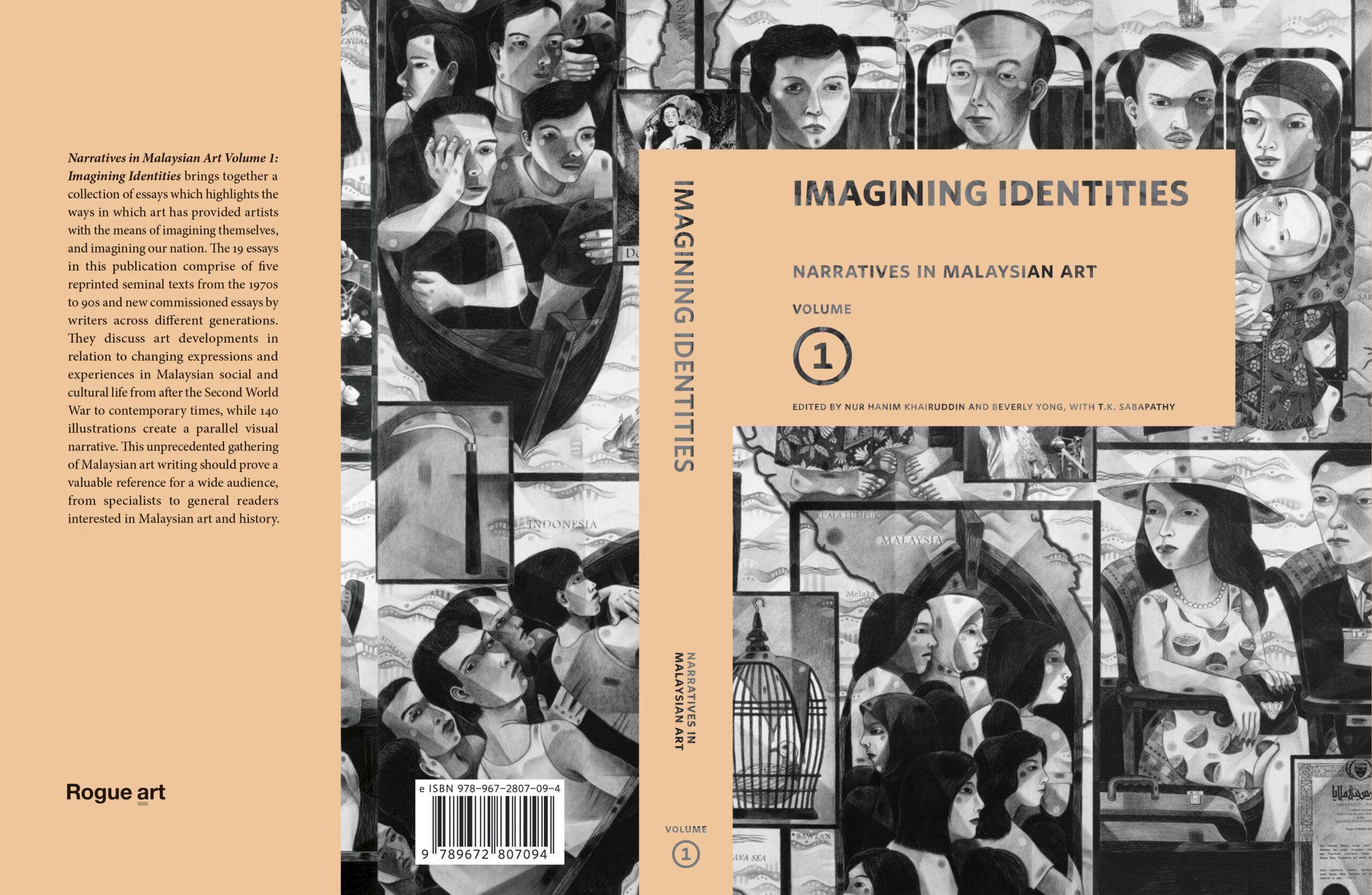
 Narratives in Malaysian Art: Volume 1: Imagining Identities, with cover art drawn from Wong Hoy Cheong’s In search of faraway places 1996 (Charcoal, photocopy transfer and collage on paper scroll / The Kenneth and Yasuko Myer Collection of Contemporary Asian Art. Purchased 1996 with funds from Michael Sidney Myer through and with the assistance of the QAG Foundation / Collection: QAGOMA / © Wong Hoy Cheong) / Image courtesy: Beverly Yong
From 2009 to 2019, I was involved in a publication project called Narratives in Malaysian Art (2012–19) — Naratif Seni Rupa Malaysia in Malay — as co-editor-in-chief alongside Malaysian artist and curator Nur Hanim Khairuddin, and as part of RogueArt,1 who project managed and ended up as publisher of the bilingual four-volume series. This was an effort to bring together disparate and patchy narrations of histories, origins, frameworks and trajectories of artmaking in Malaysia, primarily in Peninsular Malaysia, through a combination of existing and newly commissioned texts, interviews, discussions and mappings, in a context where art-historical and art-critical writing was thin and hard to access. At the time, as noted in the first volume, ‘a general public and a larger art community [seemed] to have become less and less engaged in a Malaysian art “discourse” since the mid-1990s’.2
While serving as an important record of the work of past and current artists and arts workers, Narratives in Malaysian Art (NMA) was not positioned as a celebration of specific practices and achievements. Rather, NMA as a project was an attempt to get to grips with the shape of our art histories and practices across a broad range of themes, and their significance to the artist community and to Malaysians.3 Each volume set out to be a conversation: stories, ideas and people speaking to each other — a gathering of many voices. The editorial team found ourselves framing everything in the plural.4 We troubled for some time over a format and methodology that would produce something compelling and substantial and yet stay true to the provisionality of our context, a country understood by its own artists, as we found, variously as a unified multi-ethnic nation and one fractured by communalism, a society inventing itself amid ‘colourful contestation’ between narratives — a history, in short, ‘still very much in the making’.5
We wanted NMA to be a community effort made by and for the community, as a kind of ‘nest egg for future generations’.6 The project began with a small group of five editors — all writers, curators, organisers — but also, between us, we were three artists, two translators, one educator, one erstwhile gallerist, one former journalist, two musicians and three parents, all born across the 1960s, 1970s and 1980s. Having co-opted Singaporean art historian TK Sabapathy, a veteran of South-East Asian art scholarship, as a consulting editor,7 we then spoke to around 30 writers to find out what they might be interested to explore. By the late noughties, what had once seemed a fairly close-knit visual arts scene had grown exponentially. With that had come a thinning of communication between generations, language groups, faculty and alumni from different institutions — and even between artists, who found themselves on different kinds of career paths. Wishfully, perhaps, I hoped NMA would be a means of reinforcing existing bridges and building new ones.8 The bilingual format — a translation both ways, and in one instance, a three-way translation from Mandarin to English to Malay — would be key to this.9 We were anxious to know whether an art community at large wanted this publication and would get behind it.
In early December 2009, we introduced the project with ‘Talk the Walk: A Discussion on Narratives in Malaysian Art’. (Malaysians like to make bad puns in English, perhaps as a gentle jibe at our colonial inheritance.) We began inviting feedback, further ideas, knowledge, resources, funds and in-kind contributions. A reasonably large and motley group of artists, writers and art supporters came. Hasnul Jamal Saidon, one of the original editorial group, performed with his band, and Ise (aka Roslisham Ismail) designed a ‘Kawan Buku’ (‘Friend of the Book’) badge for supporters. We handed around a hat to raise the substantial budget needed and tried to involve as many people and organisations as possible. We got a kick-off grant from the Krishen Jit Fund;10 friends, collectors, gallerists, corporations and, importantly, the Lembaga Pembangunan Seni Visual Negara, also chipped in;11 and we were fortunate to have what we raised matched by a heritage foundation linked to the Malaysian Government’s investment arm. Proceeds from sales were to cover any shortfall and were otherwise dedicated to related knowledge projects. This funding model, we hoped, would maintain the niat (motivation) of the project as one of shared ownership and collective investment. Through several structural redrafts, and after receiving crucial advice about the challenges of assembling and distributing a 500-page volume, we settled on a four-volume format for ‘the Great Malaysian Art Book’ (as we jokingly called it, after artist and critic Redza Piyadasa’s deconstructive work The Great Malaysian Landscape [1972]12) to be rolled out gradually. By this stage, Nur Hanim and I, with TK Sabapathy, had been left holding the baby, so to speak, and our original co-editors became contributors across the volumes. Taking a modular, organic approach, we began with existing texts we knew of between us that proposed a broad, compelling survey and critique of specific developments in the art scene; or claimed a position on local and/or regional art trajectories. Our aim was to build around these initial texts, identifying gaps in the scholarship and seeing how new texts or conversations might chime in, challenge and expand outwards from these. Besides two essays by TK Sabapathy, the republished texts composed before the 1990s were written by artists; it was particularly important for us to include artists’ voices throughout the project so they would remain present and active in the discourse around their practices, and in interpretations of our art histories. Each volume was published in English and Malay editions, and the respective editorial teams selected a pair of images to appear on the two covers, based on a consideration of the context and readings of the artworks as images reflecting the narrative gist of each book. Here, I attempt a reading of the four volumes, across both English and Malay editions, through their cover images.
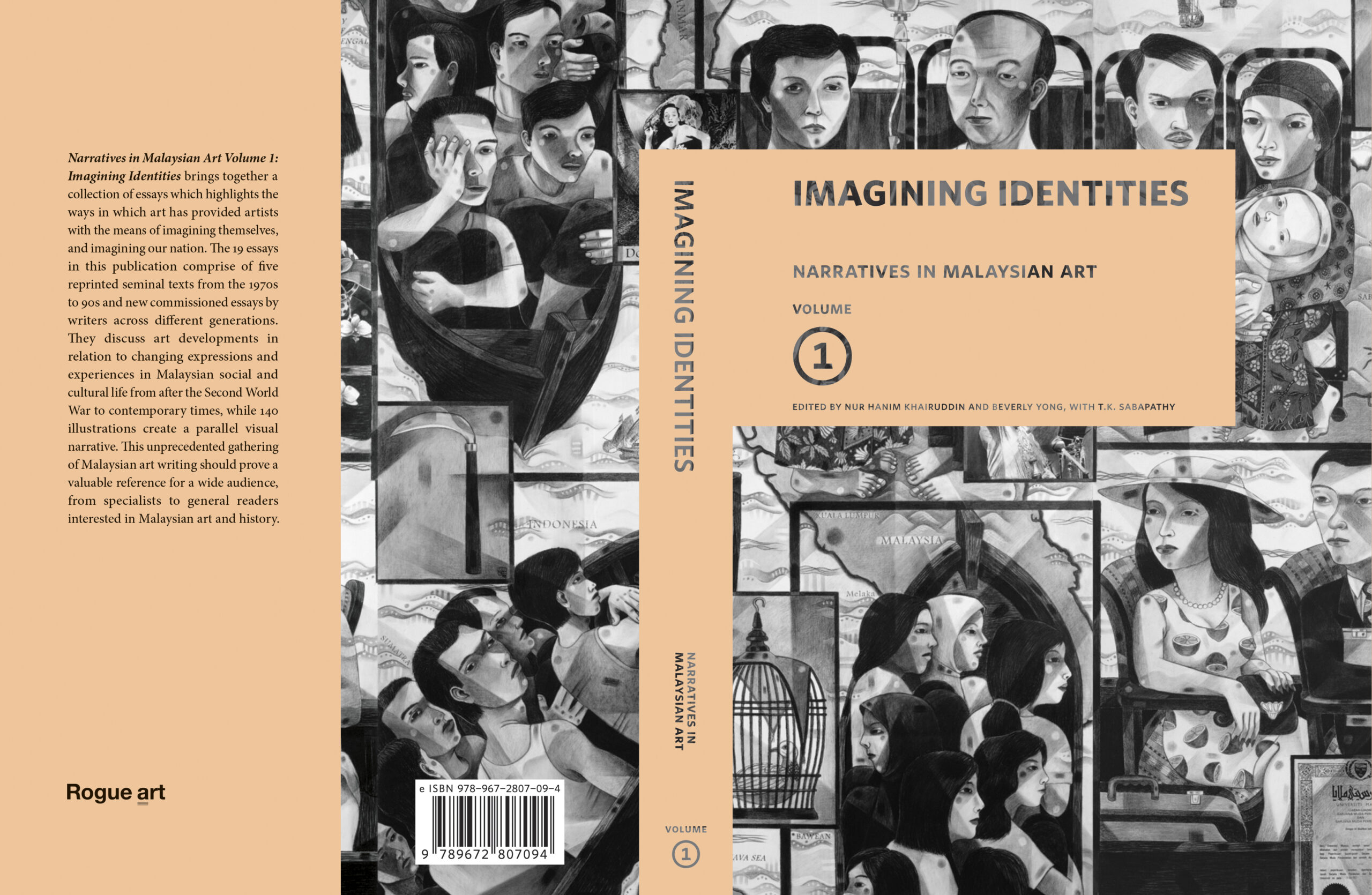 Narratives in Malaysian Art: Volume 1: Imagining Identities, with cover art drawn from Wong Hoy Cheong’s In search of faraway places 1996 (Charcoal, photocopy transfer and collage on paper scroll / The Kenneth and Yasuko Myer Collection of Contemporary Asian Art. Purchased 1996 with funds from Michael Sidney Myer through and with the assistance of the QAG Foundation / Collection: QAGOMA / © Wong Hoy Cheong) / Image courtesy: Beverly Yong
Published in 2012, Narratives in Malaysian Art: Volume 1: Imagining Identities explores Malaysian art histories and practices in a deliberately subjective register, across a two-part structure: ‘The journey between the rural and the urban, and the building of a nation’ and ‘Claiming/reclaiming identities: Negotiating tradition and modernity’. On the cover of this English-language edition is a detail from Wong Hoy Cheong’s charcoal drawing In search of faraway places 1996. The large-scale triptych, which formed the centrepiece of Wong’s solo exhibition ‘Of Migrants and Rubber Trees’ at the Creative Centre of the National Art Gallery in Kuala Lumpur, 1996, is now held by the Queensland Art Gallery | Gallery of Modern Art (QAGOMA) in Brisbane, Australia. In the exhibition, Wong traced and retold the lives of migrants over generations, tying them to histories of colonialism, labour and nation-building, and to the formation and perception of social and cultural identities among migrants and their descendants.13 The drawing expands outwards from the artist’s own family’s stories, featuring diverse groups of people in boats travelling across the seas on a giant map, both towards and away from Malaysia.
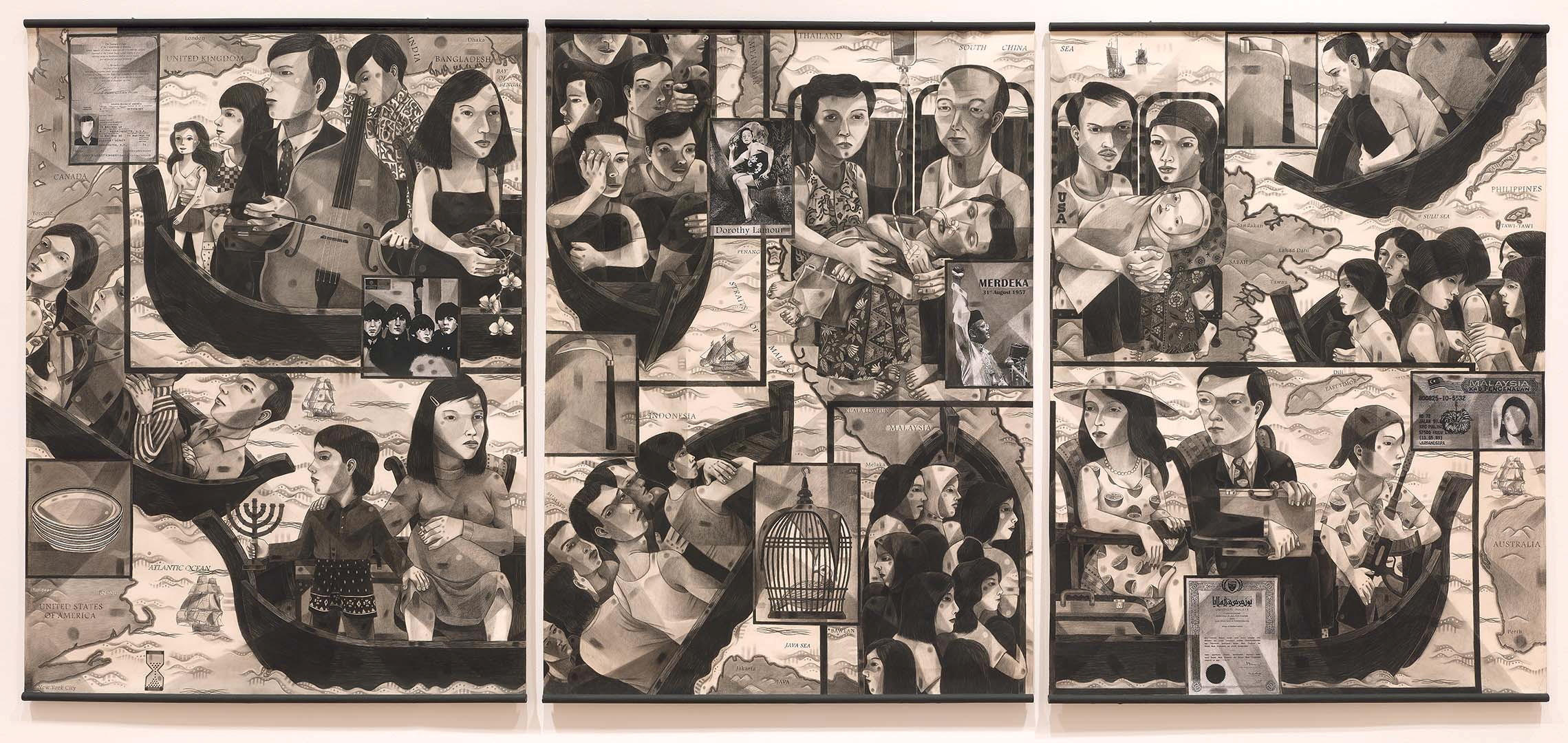 Wong Hoy Cheong / Malaysia b.1960 / In search of faraway places (from 'Migrants' series) 1996 / Charcoal, photocopy transfer and collage on paper scroll / The Kenneth and Yasuko Myer Collection of Contemporary Asian Art. Purchased 1996 with funds from Michael Sidney Myer through and with the assistance of the QAG Foundation / Collection: QAGOMA / © Wong Hoy Cheong
The cover detail is taken from the centre of Wong’s work. In the artwork, we have the outline of the Malay Peninsula — with the southern end of Banjaran Titiwangsa (the Titiwangsa Range) forming her mountainous spine — and the words ‘MALAYSIA’ and ‘KUALA LUMPUR’ clearly designated. Each boatload of people is boxed in its own separate frame, like the pieces of a puzzle coming together. Their ethnicities, social backgrounds and historical contexts are suggested by their headdresses or clothes: migrant workers, students inbound from China, Indonesia or Myanmar, perhaps; as well as affluent families heading out to Australia and the West. Smaller frames within the work provide suggestive keys: a rubber-tapping knife, holding stories of migrant labour in the extractive, capitalist economy of Empire; a caged bird, which might symbolise, by turns, colonial subjectivity, life under China’s Communist regime, the New Village communities penned in during the Malayan Emergency (1948–60), or more recent undocumented migrants in detention centres. Two couples sit in a row of high-backed chairs as if in a waiting room, with the couple on the right holding an infant.14
The overlapping of stories — with a density and diversity of characters, converging and diverging — rhymes well with the Narratives in Malaysian Art / Naratif Seni Rupa Malaysia publication as a whole. The image itself, meanwhile, folds in many of the themes of the volume’s first section: the imagination of and identification with place; the movements and aspirations of people shaping new worlds; the representation of the figure and of identity; and the picturing of multiculturalism. In Part 1 of the first volume, readers meet British maritime watercolourists from the early twentieth century; encounter art clubs for British civil servants and their wives; and are introduced to artists from China, trained in both Chinese and European traditions, who were enchanted with the landscapes and peoples of the Nanyang (South Sea). From these early pictorial framings, the essays move to ‘Malaysian artists shift[ing] the focus from the observed to the observer — Malaysians depict[ing] themselves to each other’,15 while exploring the means of describing the experience of home and nation as a changing environment, through to the immediate contemporary.
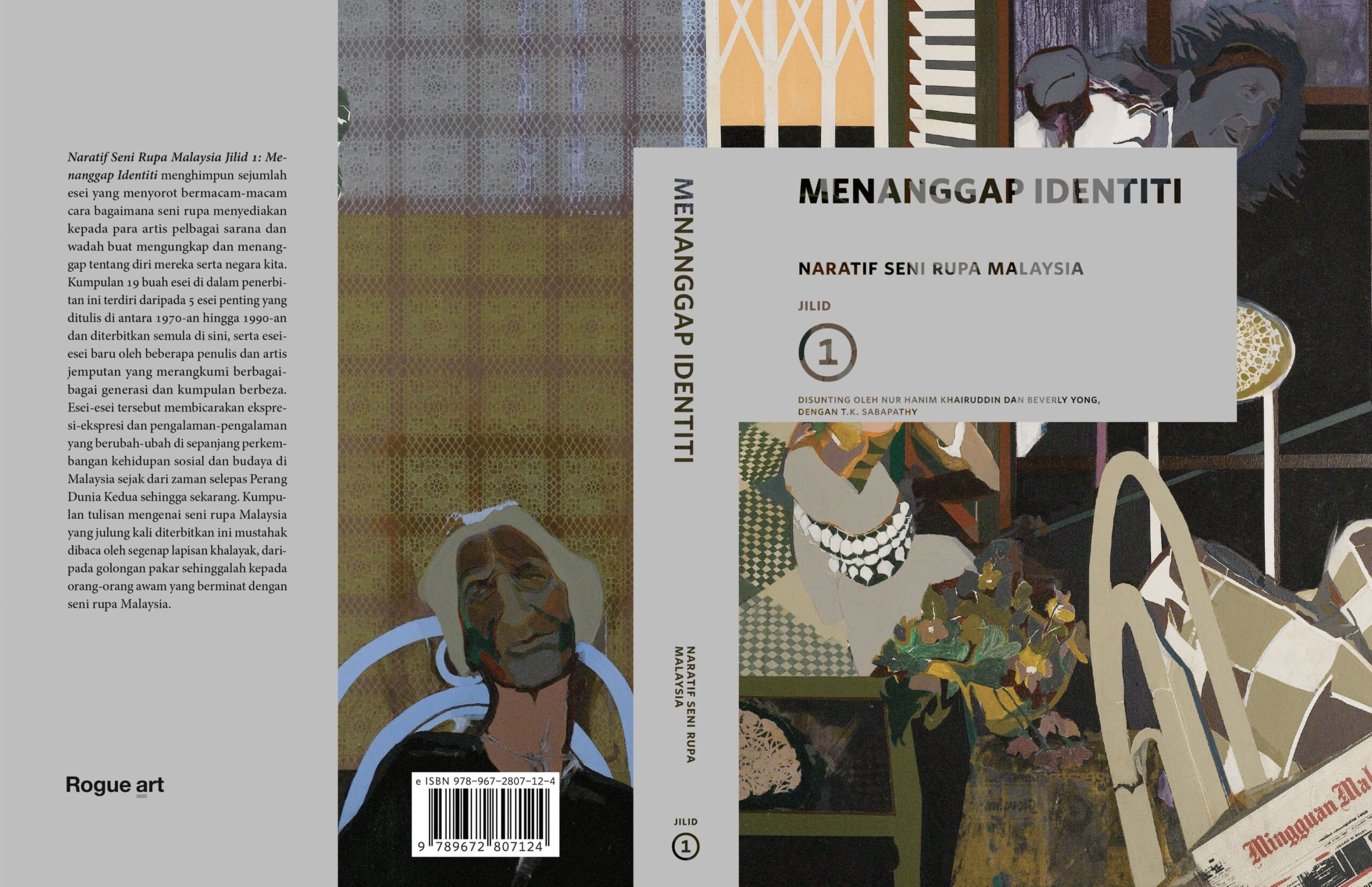 The first Malay edition of Naratif Seni Rupa Malaysia, Jilid 1: Menanggap Identiti, with cover art drawn from Ismail Zain’s painting DOT: The Detribalization of Tam Binte Che’ Lat 1983 / © Estate of Ismail Zain / Image courtesy: Beverly Yong
For Jilid 1: Menanggap Identiti, the first volume’s Malay edition, we chose a detail from Ismail Zain’s painting DOT: The Detribalization of Tam Binte Che’ Lat 1983. An artist, educator and cultural bureaucrat, Ismail Zain (1930–91) was something of a catalyst and visionary in his time, who thought deeply about the trajectory of art development in a regional context of long artistic traditions, globalisation and nascent infrastructure.16 Like Wong’s charcoal drawing, DOT is a puzzle of pieces coming together — a painted collage of cultural signifiers pasting up a domestic interior scene. There are further parallels: a closed accordion iron grille shuts in the scene like a birdcage; and two figures seated on ratan chairs — one is largely concealed, indicated only by the check pattern of kain pelikat (a man’s sarong) across his lap and the Malay-language tabloid he holds, peeking out from the corner of the painting. The other figure appears to be an elderly woman — presumably named Tam Binte Che’ Lat — who leans back uncomfortably with something barbed around her neck. Her face has been painted dark and bruised, with a weary, distant expression, and is framed by the finely embroidered weave of a screen made of songket (a handwoven brocade textile). Around the figures are a partially erased figure in a belly-dancer’s outfit, a potted plant, the simple weave of a mengkuang mat, lace doilies on utilitarian occasional tables and, improbably, the spectre of 1980s tennis star Björn Borg, springing into action.
The rhythmic visual languages and embedded knowledge of centuries-old textile art traditions collide in DOT with the material detritus of global modernism and the colonial experience. The painting describes an experience very far from the pastoral ideal of communal rural life that formed the subject of much figurative painting up to just over a decade before. It registers a profound cultural and socioeconomic shift: here is a domestic interior reconfigured by industrialisation, urban migration, and the aspirations of a then newly emergent middle class, shaped by the global circulation of Western culture; here is a modernity, layered and fragmentary — one that does not unfold evenly or benignly for all those who inhabit it.
Beyond the frame of DOT, a National Cultural Congress,17 the 1979 Islamic Revolution in Iran and the dakwah movements in Malaysia, Singapore and Indonesia — alongside global countercultural movements and developments in cultural theory — fed into an increasingly charged and complex context for artistic practice. If both of the volumes’ cover images suggest density and transition, this detail from DOT also registers disjunction: the strain inherent in the process of ‘imagining identities’ amid competing ideological, religious and aesthetic frameworks. It offers a kind of map for the second part of the volume, where writers consider definitions, philosophies and artistic languages rooted in local and regional Malay cultural traditions and in Islam; the development of modern sculpture and abstract painting; as well as ideological, political and social readings of our recent art histories.
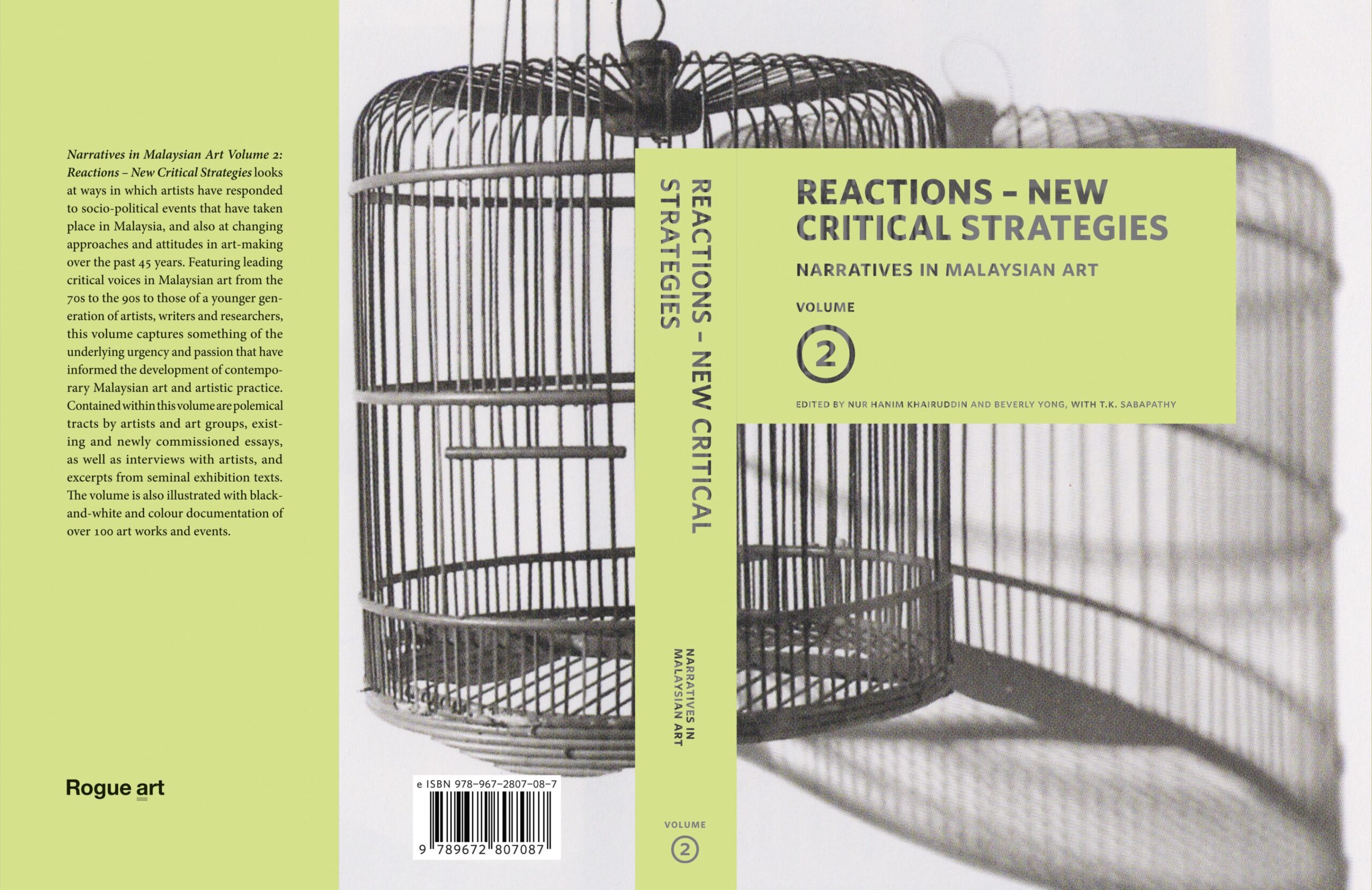 Volume 2: Reactions – New Critical Strategies, with an installation view of Redza Piyadasa and Sulaiman Esa’s Empty bird-cage after release of bird at 2.56 p.m., on Monday 10th June 1974 1974 / © The artists / Image courtesy: Beverly Yong
Volume 2: Reactions – New Critical Strategies (2013) begins in the 1970s and extends into contemporary practice at the time of publication. Its cover images signal the volume’s dual narrative strands: the development and proliferation of critical strategies, traced through manifestos, conversations and essays; and a retelling of key social and political events in Malaysian history through 14 works (or bodies of work) and an exhibition, presented via artist interviews and excerpted texts. By happy accident — or perhaps subconscious editorial direction — the birdcage and seated figures reappear again on the English and Malay editions respectively.
On the cover of Reactions is photographic documentation of Redza Piyadasa and Sulaiman Esa’s Empty bird-cage after release of bird at 2.56 p.m., on Monday 10th June 1974 1974. The birdcage in question formed part of a group of found everyday objects, each connected by its description with an earlier event, and presented by the artists in ‘Towards a Mystical Reality’ — the landmark exhibition of their ‘Jointly Initiated Experiences’ project, held at the Writer’s Corner of Dewan Bahasa dan Pustaka, Kuala Lumpur, in August 1974. The exhibition was accompanied by one of the two 1974 manifestos that open the volume, in which the artists described the exhibition as an effort to ‘SOW THE SEEDS FOR A THINKING PROCESS WHICH MIGHT SOMEDAY LIBERATE MALAYSIAN ARTISTS FROM THEIR DEPENDENCE ON WESTERN INFLUENCES’.18 The open birdcage can therefore be read as a metaphor for a release from the cage of inherited or ‘borrowed’ precepts of modern art. The cage also resonates with the restrictions on life and creativity described in ‘Manifesto Generasi Anak Alam’,19 which the new collective sought to break through with their fellow artists: ‘machines assuming control’, ‘the ropes and nets of bureaucracy’, also blinkeredness and conservatism, environmental degradation and industrial pollution, divisions of ancestry, skin colour, beliefs, age, gender and length of hair, and the relegation of art to ‘a hobby attached to status’. In this light, the empty birdcage, casting its long shadow on the wall, is emblematic of the many ways in which artists in Malaysia have come to shape their own critical languages of artmaking described in the volume — a kind of freedom won through criticality and collective agency.
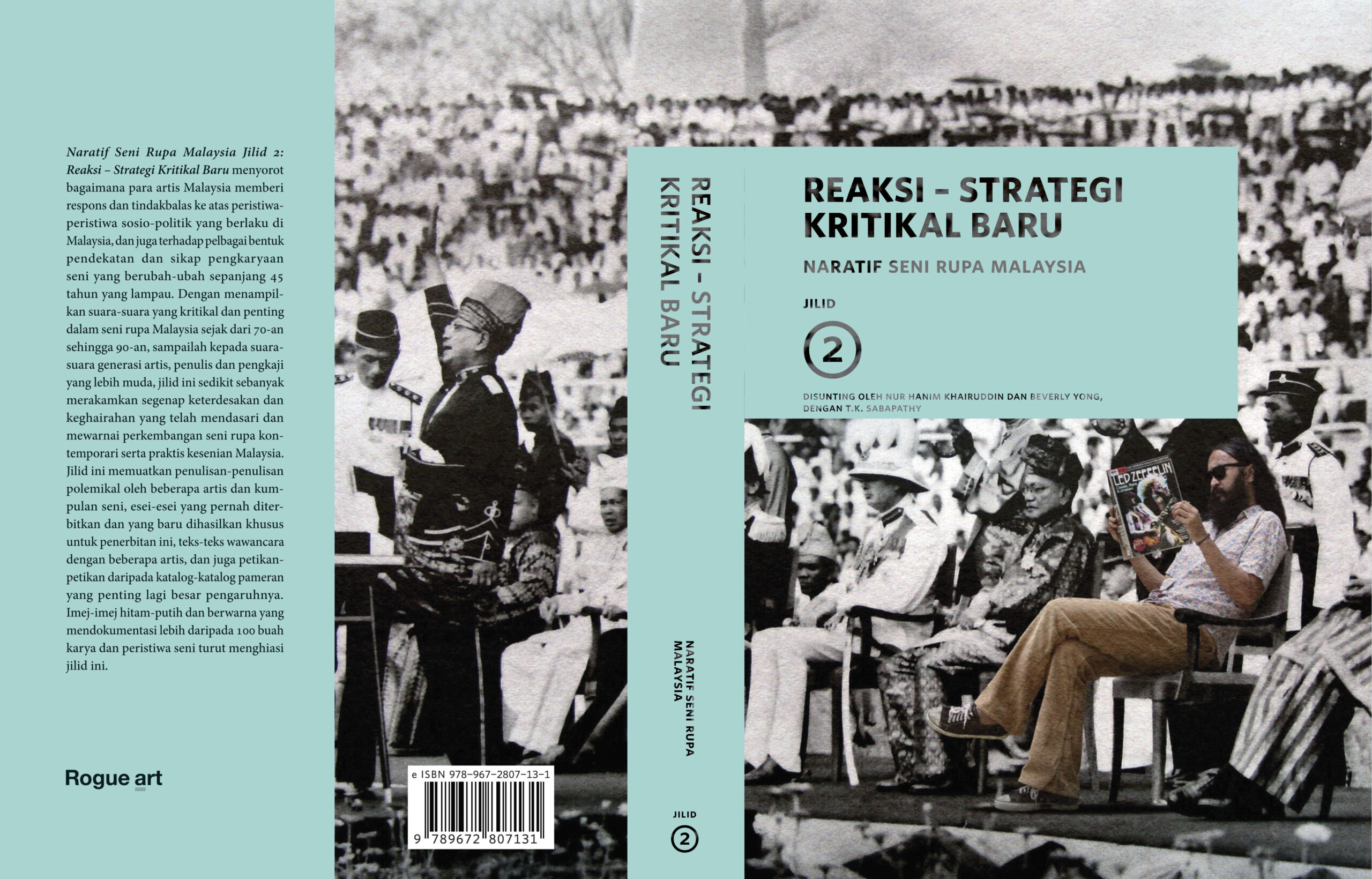 Jilid 2: Reaksi – Strategi Kritikal Baru, with cover art drawn from Ahmad Fuad Osman’s Recollections of Long Lost Memories 2007 / © Ahmad Fuad Osman / Image courtesy: Beverly Yong
On the cover of Jilid 2: Reaksi – Strategi Kritikal Baru is a detail from one of 71 manipulated archival photographs in Recollections of Long Lost Memories 2007 by Ahmad Fuad Osman. Here, at Stadium Merdeka in Kuala Lumpur on 31 August 1957, a young hipster from the 2000s — the only figure rendered in colour within an otherwise black-and-white image — has taken up the empty seat alongside the Agong (the King of Malaysia) vacated by prime minister Tunku Abdul Rahman, who now stands at the front of the stage proclaiming Malaya’s independence from British rule. In Malay, ‘to live’ somewhere is ‘to sit’ somewhere — duduk — traditionally, on the ground. The chair, by contrast, is a colonial import in this part of the world, and in modern Malaysian painting, it often functions as a framing device or a proxy for colonialism, situating both the figure and their point of view. On the covers of both Imagining Identities and Menanggap Identiti, chairs support subjects seated in anticipation or resignation. Here, however, they are unmistakably seats of power and privilege: to have a ‘time tourist’ — who is casually reading about Led Zeppelin and seemingly oblivious to the momentous occasion, occupying one of those seats — unsettles the scene. It poses questions about how and when we enter and read history, and how that history is inhabited or reimagined by generations coming of age decades later.
Fuad’s Recollections of Long Lost Memories operates as a kind of national photo album, capturing 71 moments in Malaysian history and recasting them as entries in a personal travel journal. Throughout the second volume, the 14 artworks and artist interviews function in a similar way: training a critical lens on key events and phenomena embedded in Malaysians’ collective memory — often sites of trauma, and almost all involving either the formation, the transfer or the abuse of political power.
For the next two volumes of NMA, with new co-editors joining us,20 we became more playful and direct in choosing images we thought captured succinctly some of the questions and findings they brought to light. The third volume — Volume 3: Infrastructures and Jilid 3: Infrastruktur (2016) — is by far the heftiest of the four, with the Malay edition extending beyond 500 pages as it takes stock of the local art scene, past and present. For the covers, we decided on two works that take on Malaysian architecture, referencing the ‘structural’ aspect of this volume.
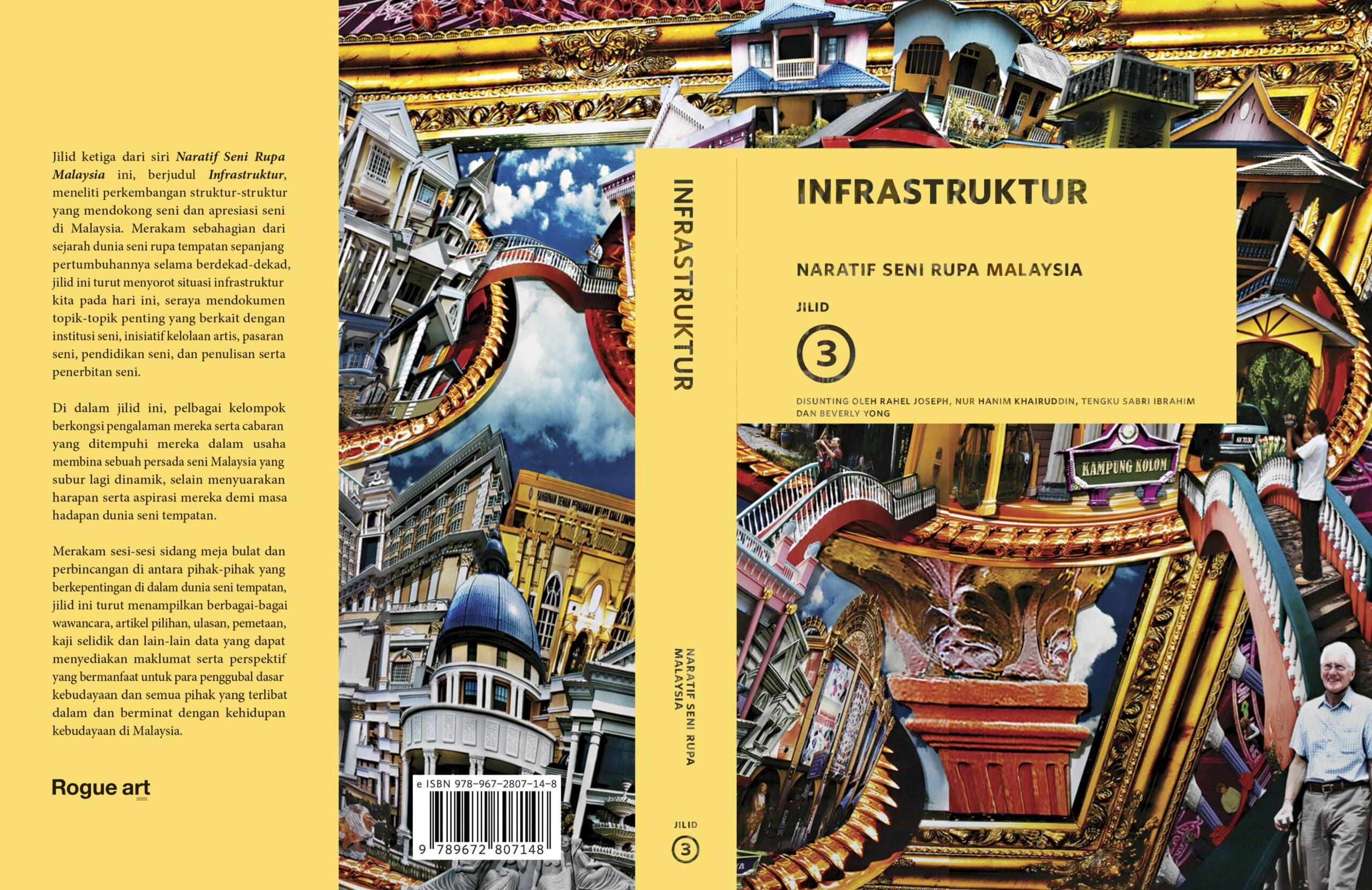 Jilid 3: Infrastruktur, with cover art drawn from Liew Kung Yu’s photocollage Bandar Sri Tiang Kolom (from ‘Cadangan-Cadangan Untuk Negaraku (Proposals for My Country)’ series) 2009 / © Liew Kung Yu / Image courtesy: Beverly Yong
For Infrastruktur, the garish, aspirational and ‘simply-simply put together’ facades, bridges and follies of Liew Kung Yu’s photocollage Bandar Sri Tiang Kolom (from ‘Cadangan-Cadangan Untuk Negaraku (Proposals for My Country)’ series) 2009 seemed an apt metaphor for the state of our formal art infrastructure. Carelessly adopted Western idioms — including the neoclassical kolom (columns) of the title — are squeezed into odd shapes and stuck onto traditional local elements in a haphazard townscape, presented on golden trays bursting out of a gilded picture frame. From the 1950s, Malaya (joining Sabah, Sarawak and Singapore to form Malaysia in 1963) took on the Western model of a modern art system — art school, studio, gallery, collector, museum. While this framework has provided a kind of ballast and economy for art production, it has proved inadequate for sustaining art as an integral part of social and cultural life and meaning-making, particularly without committed public investment in our state institutions.
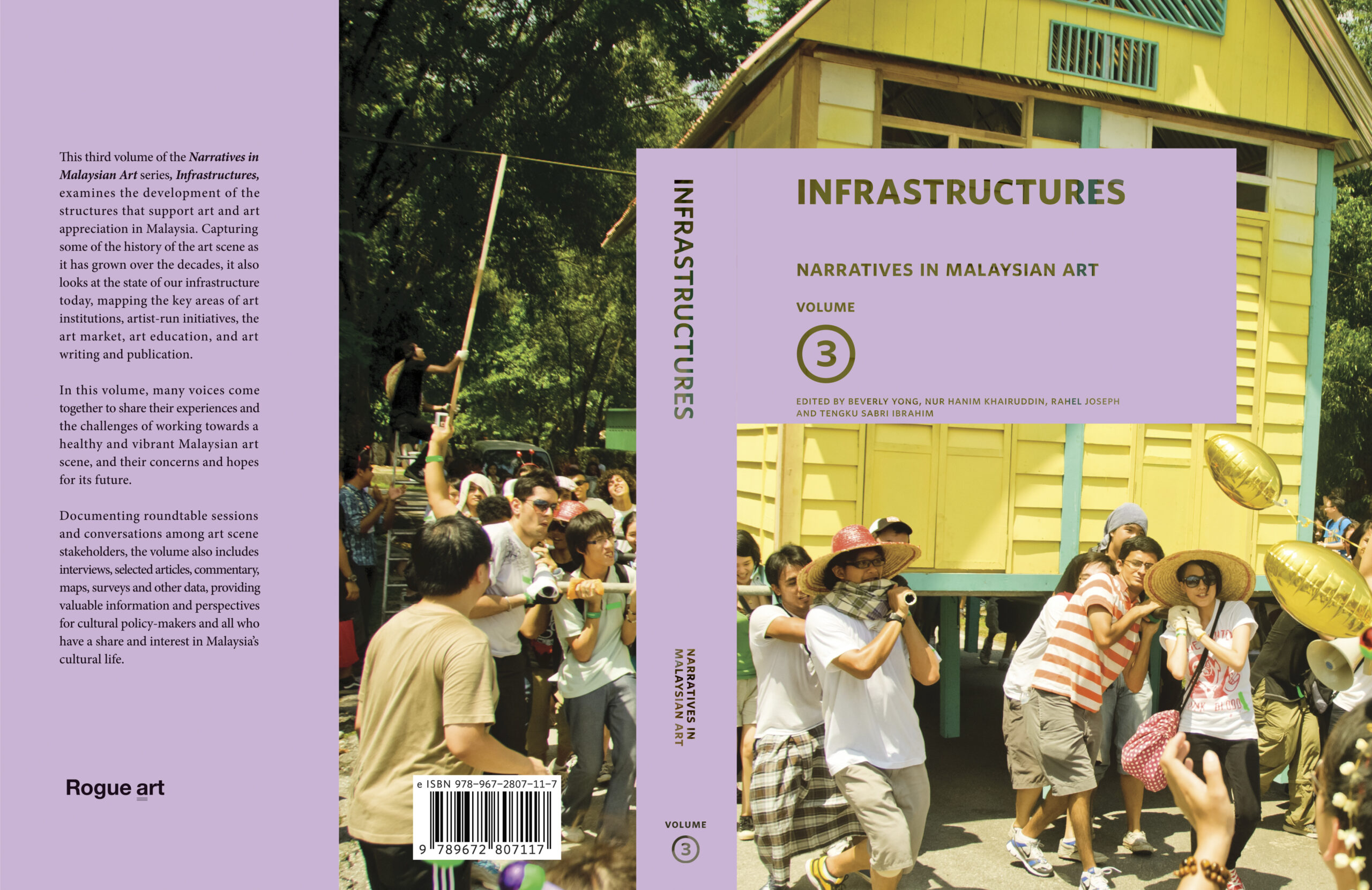 Volume 3: Infrastructures, featuring a still from Projek Angkat Rumah 2010 by filmmaker Liew Seng Tat / © Liew Seng Tat / Image courtesy: Beverly Yong
For Infrastructures, our choice of Projek Angkat Rumah 2010 by filmmaker Liew Seng Tat in collaboration with Five Arts Centre offers a counterpoint. Calling for volunteers to participate in a traditional gotong royong activity,21 the work presents an obverse model of infrastructure: dozens of people from different backgrounds physically carrying a wooden kampong house together. Where Liew’s collage suggests a precarious, imported formal structure, this image foregrounds the celebration of local community collaboration, shared labour and collective agency. This gesture mirrors the volume’s own process, which involved more than a hundred people — artists, patrons, collectives, arts workers across institutions and galleries, collectors, educators, researchers, writers — through roundtables, interviews, mapping exercises, survey essays, short reflections and reports. From its beginnings up until the mid-1990s, the local art scene was largely artist-driven, often by practitioners in institutional leadership roles. By the mid-2010s, it felt once again as if artist initiatives — 18 of which participated in the Turun Padang session in 201322 — were doing some of the most meaningful work in public engagement, driving discourse and community-building. Throughout the editorial process, committed and passionate individuals across sectors shared critique, experiences and ideas; even if these perspectives sometimes seemed very different or even at odds, we found at the very least a shared sense of investment in the ecology of art — institutions, artist initiatives, the art market, art writing and education.
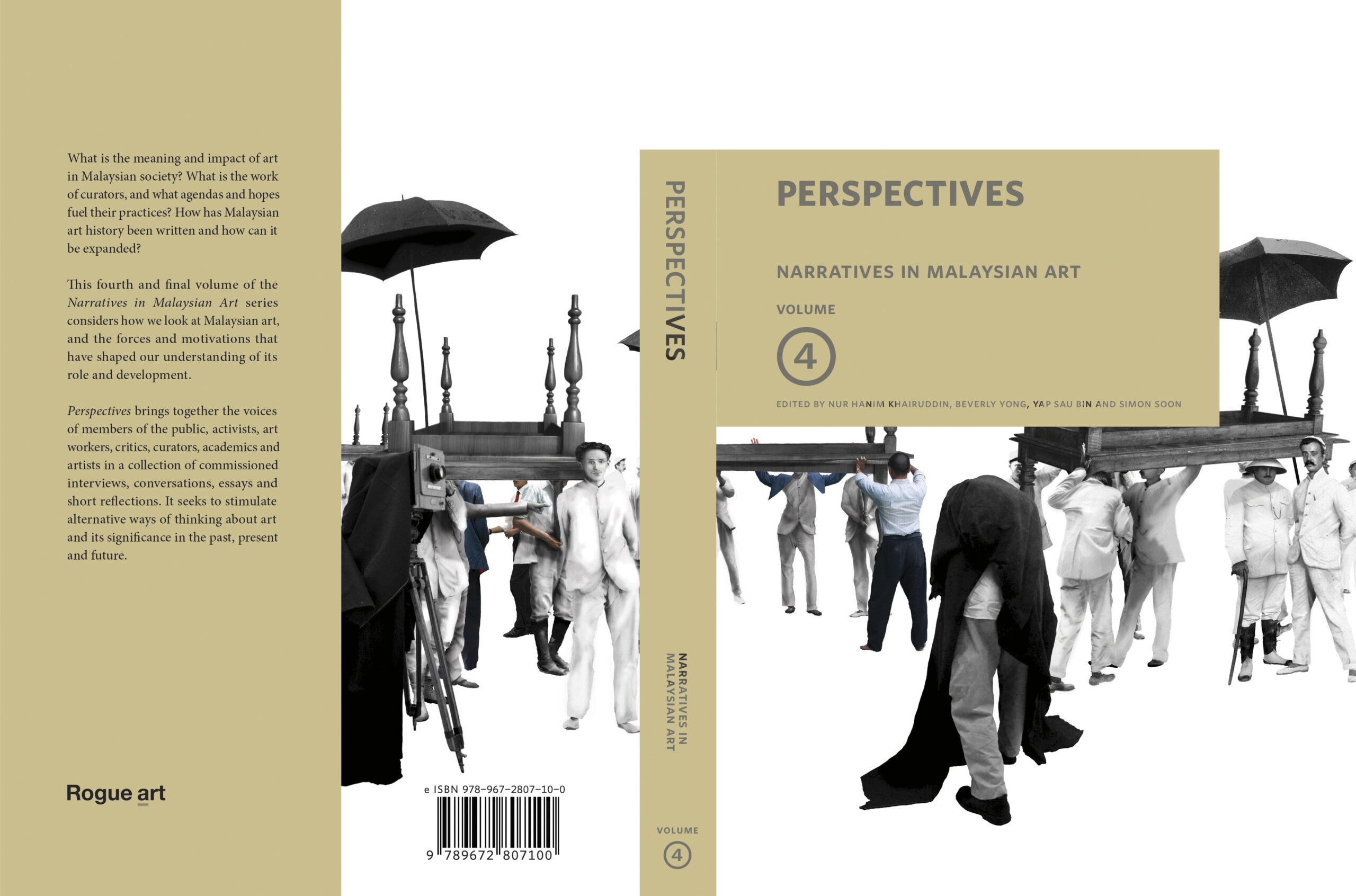 Volume 4: Perspectives, with cover art drawn from Yee I-Lann’s Picturing Power: Wherein one surreptitiously performs reconnaissance to collect views and freeze points of view to be reflective of one’s own kind 2013 / © Yee I-Lann / Image courtesy: Beverly Yong
For the final volume of the series, the idea was to take a step back and feel around the edges for how ‘Malaysian art’ is framed and perceived, with three sections exploring art in the public sphere, curatorial frameworks and agendas, and the writing of art history itself. For Volume 4: Perspectives (2019), a detail from Yee I-Lann’s Picturing Power: Wherein one surreptitiously performs reconnaissance to collect views and freeze points of view to be reflective of one’s own kind 2013, shows photographers with cameras pointing in different directions at their subjects — a neat visualisation of the volume’s approach. It dawns on me now that, like the artwork detail from Projek Angkat Rumah for the cover of the third volume’s English edition, this detail also features people carrying heavy objects. Here, however, they are dressed as peons and clerks of the colonial period, or as modern business executives, holding aloft large colonial-era tables turned upside down. Reading between the two images offers much to consider about how, as individuals and communities, we see the cultural, social and political structures and systems we have inherited, and how we might want to use our energies to move them along.
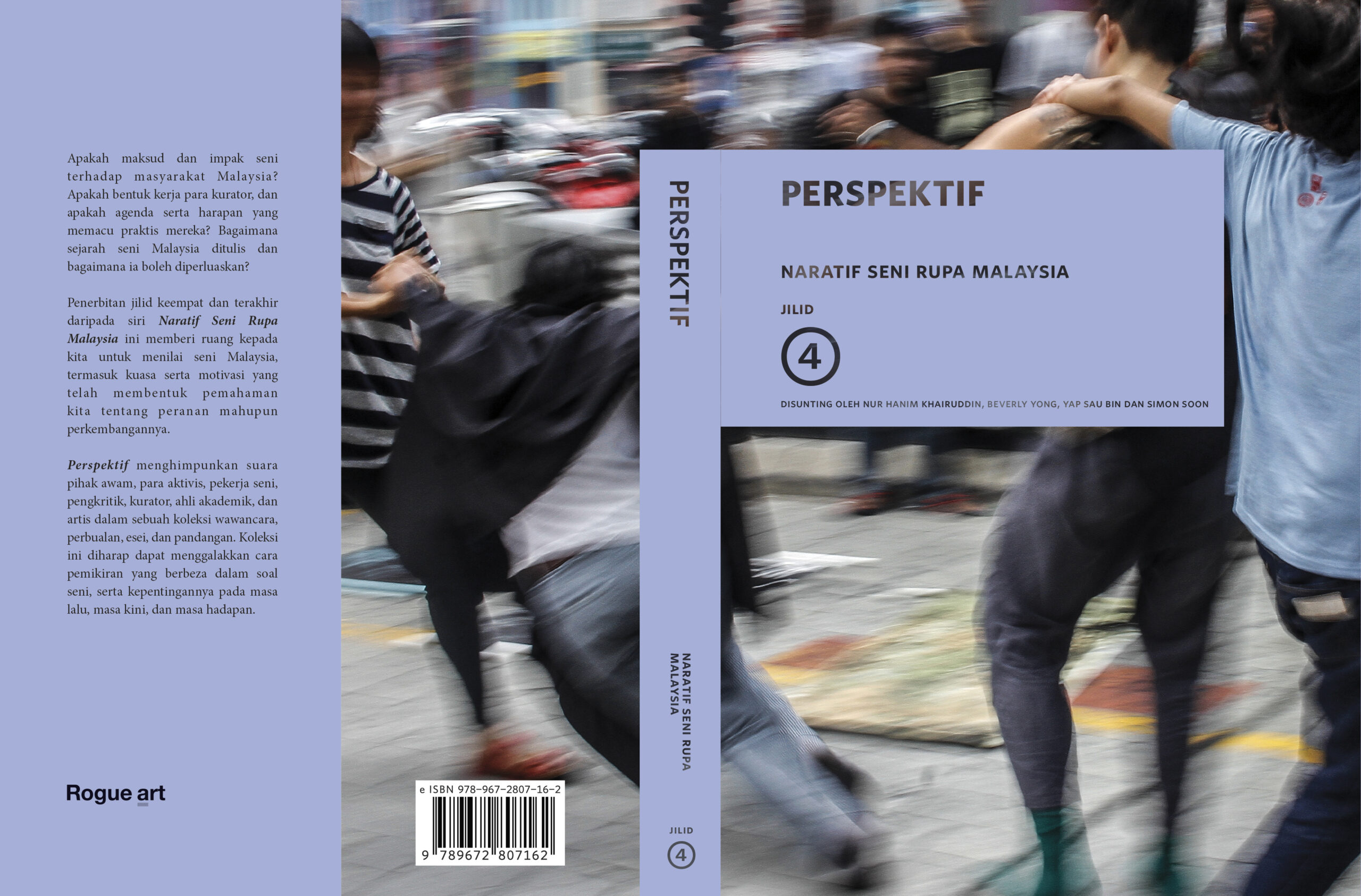 Jilid 4: Perspektif, with cover art drawn from documentation of a performance called Lepas Tangan 2016, by Sharon Chin with Intan Rafiza and Aisyah Baharudin / © The artists / Image courtesy: Beverly Yong
On the cover of Jilid 4: Perspektif is a blurry photograph of Lepas Tangan 2016 — a performance by Sharon Chin with Intan Rafiza and Aisyah Baharudin. In Malay, the title phrase literally means the releasing or letting go of hands. The work was performed during a protest by more than 200 artists and other members of the arts community against the abrupt demolition of national laureate Syed Ahmad Jamal’s public sculpture, Puncak Purnama (Lunar Peaks) 1986, in the heart of Kuala Lumpur — a rare, possibly singular, moment of artists and supporters coming together to defend the moral rights of an artist and and a piece of their own art history.23 In the performance, the three women artists began by holding one another’s arms; gradually, more people joined, forming ‘a human chain of love and pain, tearing each other with the effort of keeping together’, holding on until they had to let go.24
Perhaps it is a kind of luxury that art scenes on the periphery, often crude, provisional, roughly hewn or patched together, enjoy — to be acutely conscious that there is much work to be done, of being in the making. The NMA project was a collaborative attempt to move along that making process through writing, documentation and conversation. In scrutinising the stories and visual information embedded in each of its eight covers, I am struck by the connections between them, reminded that, not only are artists always trying to tell us something, but the ways in which their works, practices and stories come together over time, forming what we might call our art histories, in the broadest sense, may also be trying to tell us something. When planning the project, we were wisely cautioned by TK Sabapathy to use the term ‘art history’ with care and restraint, and to acknowledge the parameters and rigours of the discipline, especially when working with recent and current practices and a wide range of texts and sources. Narratives in Malaysian Art / Naratif Seni Rupa Malaysia nonetheless celebrates art history as a means by which individuals and groups have sought to make sense of, or give shape to, a shared past and shared purpose; as a means of learning and reflecting together; as playing a critical, reflexive as well as storytelling role, and even a generative one. Art history as a community practice, a human chain, where artists and art workers are consciously part of its making.
Afterword
On completing the fourth volume of Narratives in Malaysian Art, ten years from the start of the project, we co-organised a series of conversations around Malaysia called ‘Walking the Talk’, to reintroduce and review the project — and to better understand the specific local stories we had missed in the books.25
Up north in Penang, a cosmopolitan site of traffic for artists over many generations, we heard about the importance of self-organisation in producing exhibitions. From early artist associations, societies and galleries to key collectives from the 1970s and the 2010s, artists described the collective as a means of ‘empowering each other . . . [and] helping each other to grow’;26 they also spoke of the challenges of underfunded institutions and the passion and sacrifices necessary to sustain them.27 We heard, too, about the intellectual ferment and creative experimentation that once underscored a university arts and humanities faculty. With George Town’s UNESCO World Heritage status and its impact on policy and tourism, the rise of street art as a popular local medium, and shifts in institutional mandates, the perception and experience of art has been changing — ‘moving from the inside to the outside’,28 while ‘becoming part of something, not standing on its own’.29
From across the South China Sea in Kota Kinabalu and Kuching in East Malaysia/Malaysian Borneo, we heard stories that barely appear in writing on modern art in Malaysia, including the one about the director of a state art gallery who discouraged interactions with global art development so that local visual art might grow, shielded from outside influences.30 Scant resources and exposure have meant there is no rulebook, no lines to draw or copy. Instead, there is room to build practices and infrastructures differently. We heard about HAUS KCH,31 started in 2016 by young creatives and managers. Today, it runs multidisciplinary exhibitions, residencies, workshops and festivals, and engages with local leaders and policy-makers to ‘nurture and advocate for the growth and well-being of Kuching’s creative industry’.32 It stands as an inspiring example of what is possible through will, energy and commitment.
In Penang and Borneo, local community art histories have been taking shape over the past decade. Before our Penang session, library collective Ruang Kongsi collaborated with the Kuala Lumpur-based Malaysia Design Archive on a 2019 symposium on Penang art history. The programme ranged from illustrated Malay manuscripts from the sixteenth and seventeenth centuries and nineteenth-century archival photographs of makyong dance to radical performance art at Universiti Sains Malaysia at the turn of the 1990s.33 Artist-driven efforts in Sarawak and Sabah have also gathered and recorded stories of artmaking across traditional disciplines and contemporary forms. These include the collective platforms Borneo Bengkel and Borneo Lab,34 as well as the work of Yee I-Lann and Harold ‘Egn’ Eswar. Meanwhile, activists working within and alongside different Orang Asli communities on the Peninsula have been developing projects to document and bring into wider discourse their respective creative cultural practices.35 For an emerging generation, art historical narratives — the documentation and recognition of practices and all the questions these may raise — help calibrate how artist and arts worker communities see their roles and positions. They also shape the kinds of ecologies, infrastructures, understandings these communities are working towards.36
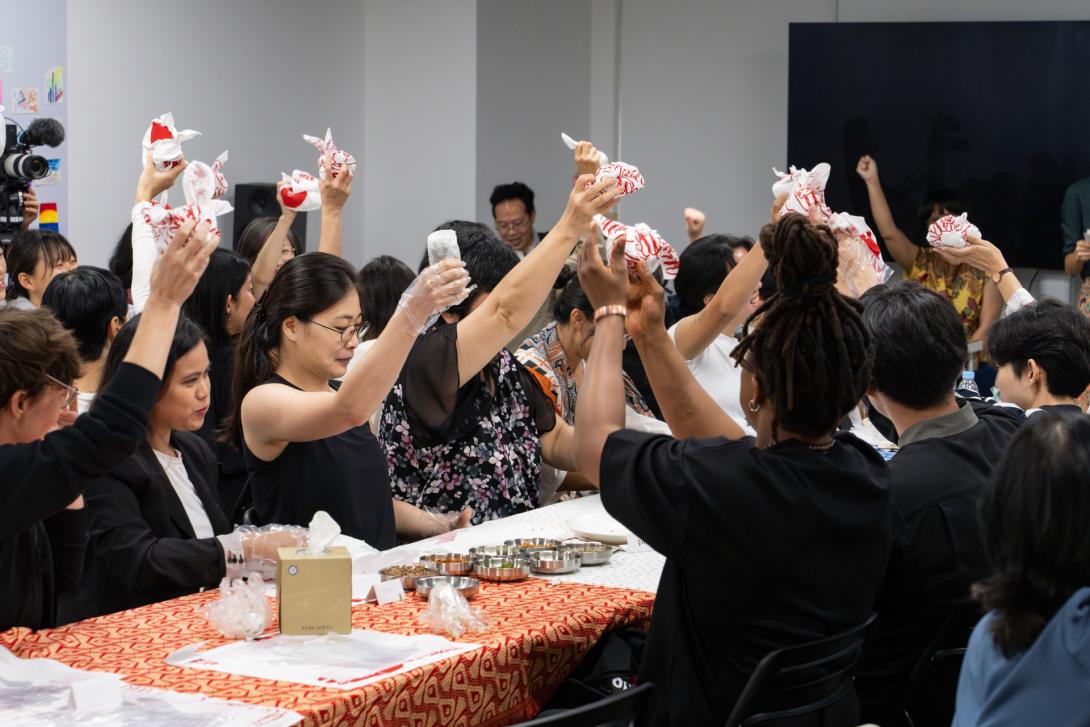 Ana Estrada, Nasrikah and Okui Lala / Domestic Resistance: Nohdong / 노동 Nongkrong, presented at the 12th Seoul Mediacity Biennale, ‘THIS TOO, IS A MAP’, Project Gallery of the Seoul Museum of Art, 24 September 2023 / Image courtesy: Seoul Museum of Art / Photograph: GLIMWORKER
In the context of the Asia Pacific Art Papers, commissioned alongside the Asia Pacific Triennial of Contemporary Art exhibition series held at QAGOMA, which brings together art practices from many traditions across different geographies, I think about how artworks and art histories from one place inform the experiences and art histories of another. I think of how Wong’s drawing In search of faraway places, exhibited in the second Asia Pacific Triennial (1996–97), sits in Australia — home to so many Malaysians and other diasporas — with its own experiences of traffic, influence and exchange. I think of how Harold ‘Egn’ Eswar’s intimate, sometimes harrowing, maps of growing up in smalltown Sabah in the eleventh Triennial (2024–25) might speak to experiences of growing up in small-town Queensland. I think of the works of Bajau Sama Dilaut weavers, and of the songs embedded in Yee I-Lann’s collaborative Dusun Karaoke: Ahaid zou noh doiti (I’ve been here a long time) 2020 in the tenth Triennial (2021–22), and how they connect with other narratives of cultural memory and resistance. I think of Ise’s Langkasuka Cookbook and public cookery lessons at the seventh Triennial (2012–13), when he presented his art practice as an offer of friendship, underlining generosity and vulnerability as necessary to the meaningful exchange of inherited knowledge. Equally, I think of Okui Lala’s collaboration with Nasrikah and Ana Estrada at the eleventh Triennial, when they created a public space for hired caregivers from across continents to share and reflect on their work and stories. It is exciting to feel these works and practices, away from home — with all the baggage they bring with them to unpack — feeding into and playing a part in transforming a larger art history into a conversation where many languages of art are recognised and many different voices heard.
The four volumes of Narratives in Malaysian in Art / Naratif Seni Rupa Malaysia may be downloaded from the project website: https://narrativesinmalaysianart.blogspot.com.